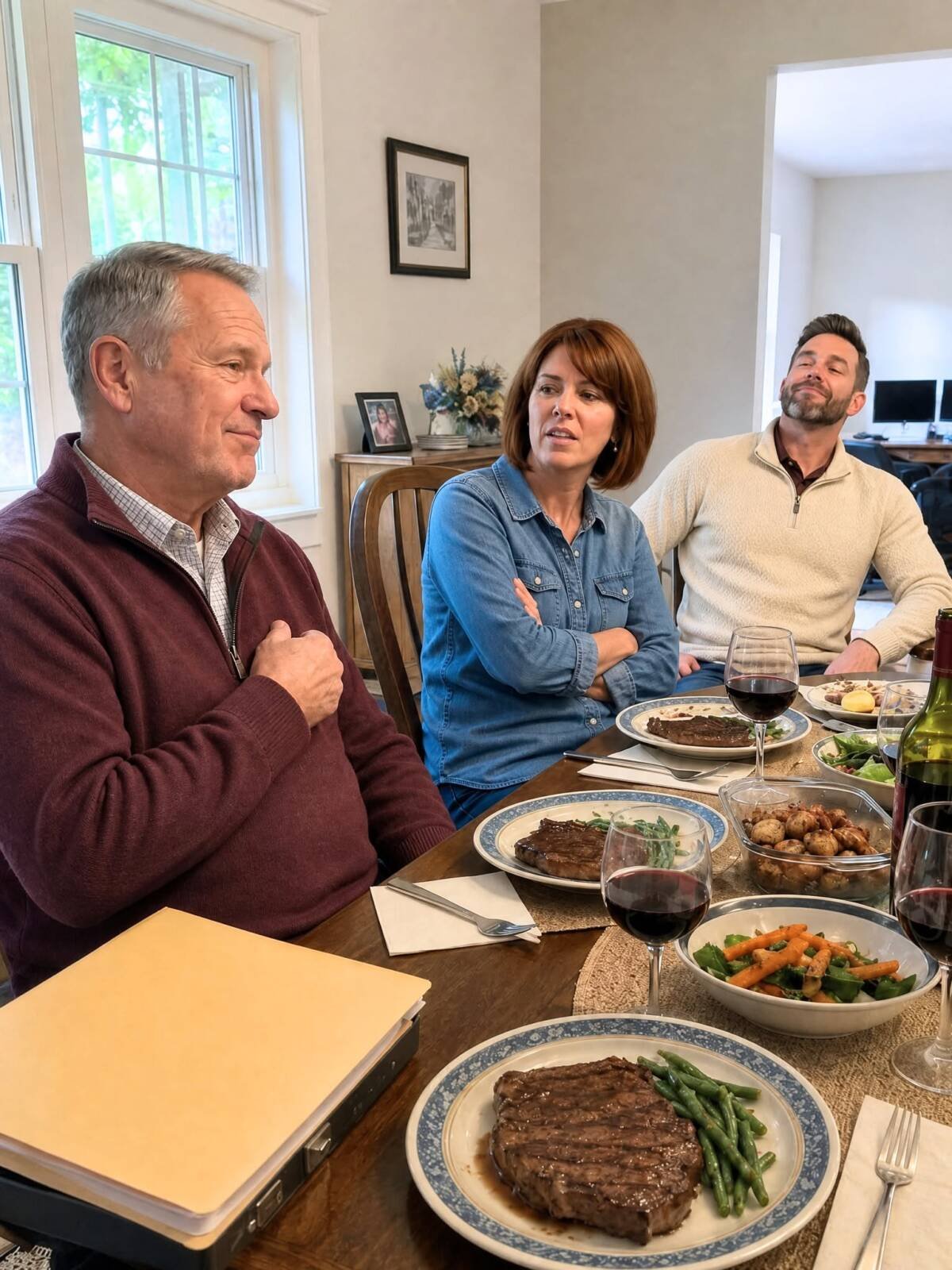
A week before Christmas, Evelyn Vance overheard a conversation she was never supposed to hear.
Her daughter was on the phone, casually discussing plans for the holidays.
“We’ll just leave all eight kids with Mom,” Becca said. “She can watch them while we enjoy a few peaceful days away.”
Evelyn stood silently in her kitchen, a coffee mug in her hand.
Her daughter had not asked whether she was available.
She had not asked whether she wanted to spend Christmas caring for eight children.
She had simply assumed.
For decades, Evelyn had been the person her family relied on whenever something needed to be done. She cooked the holiday meals, bought the groceries, wrapped the presents, prepared the bedrooms, cleaned the house, and watched her grandchildren whenever her children needed a break.
She had always told herself that was what mothers and grandmothers did.
But this time, something inside her finally changed.
Instead of arguing with her daughter, Evelyn made a quiet decision.
She would not be home when the children arrived.
And what happened next forced her entire family to confront just how much they had taken her for granted.
The Quiet Departure
My name is Evelyn Vance. I am 67 years old, widowed, and I have lived alone for several years in a quiet neighborhood where Christmas decorations begin appearing in front yards before Thanksgiving.
Every December, my house became the unofficial headquarters for our family Christmas.
There were always lights around the windows, wreaths on the front door, a large tree in the living room, and enough food in the kitchen to feed an army.
For years, I had been proud of that.
I loved having my children and grandchildren around me.
I loved seeing the house filled with laughter.
I loved watching the grandchildren tear into their presents on Christmas morning.
What I did not realize for a long time was that everyone else had gradually stopped seeing those traditions as something I chose to do.
They had started seeing them as something I was responsible for.
Every year, I paid for the groceries out of my pension. I searched for gifts, wrapped them late into the night, prepared guest rooms, cleaned the house, decorated the tree, planned the meals, and spent days making sure everything was ready.
Nobody forced me to do those things.
At least, not directly.
But over time, expectation became obligation.
And because I rarely complained, everyone assumed I was happy with the arrangement.
The previous Christmas had been particularly exhausting.
My daughter, Becca, and her husband arrived late. My son, Garrick, barely made it before dinner was served.
Everyone ate, laughed, took pictures beside the Christmas tree, and exchanged gifts.
Then, almost as quickly as they had arrived, the adults left.
They had other plans.
I stayed behind with all eight grandchildren.
I spent the evening putting air mattresses on the floors, finding extra blankets, cleaning up wrapping paper, preparing snacks, and making sure everyone was settled.
By the time the house finally became quiet, it was well after midnight.
I remember standing alone in my kitchen, looking at the mountain of dirty dishes in the sink.
I was exhausted.
But I told myself it was worth it.
They were my children.
They were my grandchildren.
That was what family was supposed to mean.
At least, that was what I had convinced myself.
Then came this Christmas.
I had already started preparing weeks in advance.
The presents were purchased.
The pantry was stocked.
The decorations were up.
The guest rooms were ready.
I had even planned the Christmas dinner menu.
Everything looked perfect from the outside.
But one afternoon, while I was in the kitchen, I heard my daughter talking on the phone in the next room.
At first, I wasn’t paying attention.
Then I heard my name.
“We’ll just leave all eight kids with Mom,” Becca said.
I stopped moving.
“She can watch them while we enjoy a few peaceful days away.”
I stood there holding my coffee mug.
For several seconds, I couldn’t move.
It wasn’t the fact that she wanted to take a vacation that hurt.
I understood that parents needed breaks.
It wasn’t even the fact that she needed childcare.
What hurt was how casually she had made the decision.
There had been no question.
No request.
No conversation.
Apparently, my availability was already part of their Christmas plans.
They had decided what I would do with my holiday without asking me.
And suddenly, something became painfully clear.
I wasn’t being treated like a mother whose time mattered.
I was being treated like a service everyone assumed would always be available.
That afternoon, I went into my bedroom and sat on the edge of my bed.
For years, I had wondered what would happen if I stopped doing everything everyone expected of me.
That day, I finally decided to find out.
I opened my notebook.
I made a few phone calls.
And without confronting anyone, I changed my Christmas plans.
The Morning Everything Changed
On December 23, my house was completely quiet.
There were no children running through the hallways.
No Christmas music was playing.
No food was cooking.
No one was asking me where something was.
Instead, my suitcase was already packed.
I carried it outside, placed it in the trunk of my car, locked the front door, and stood for a moment on the porch.
I looked back at the house.
For decades, that home had been the center of our family Christmas.
But this year, I was leaving it behind.
I got into my car and started driving toward the coast.
I had rented a small cottage in Cape May for the week.
It wasn’t extravagant.
It wasn’t some luxury vacation.
It was simply a quiet place near the water where I could spend Christmas without cooking for eight children, cleaning up after a house full of adults, or pretending that exhaustion was the same thing as happiness.
As I drove farther from home, I felt something unexpected.
Relief.
Then came the guilt.
My mind immediately began filling with questions.
What would the children think?
Would my daughter be angry?
Would my son blame me?
Would everyone accuse me of ruining Christmas?
For a moment, I almost turned the car around.
Then I remembered the conversation I had overheard.
“We’ll just leave all eight kids with Mom.”
Not Can Mom help us?
Not Would Mom mind?
Just Mom will handle it.
That was the moment I kept returning to.
And I continued driving.
The Phone Call at the Coast
I hadn’t even reached the edge of the county when my phone started ringing.
It was Becca.
I let it ring.
A few minutes later, she called again.....