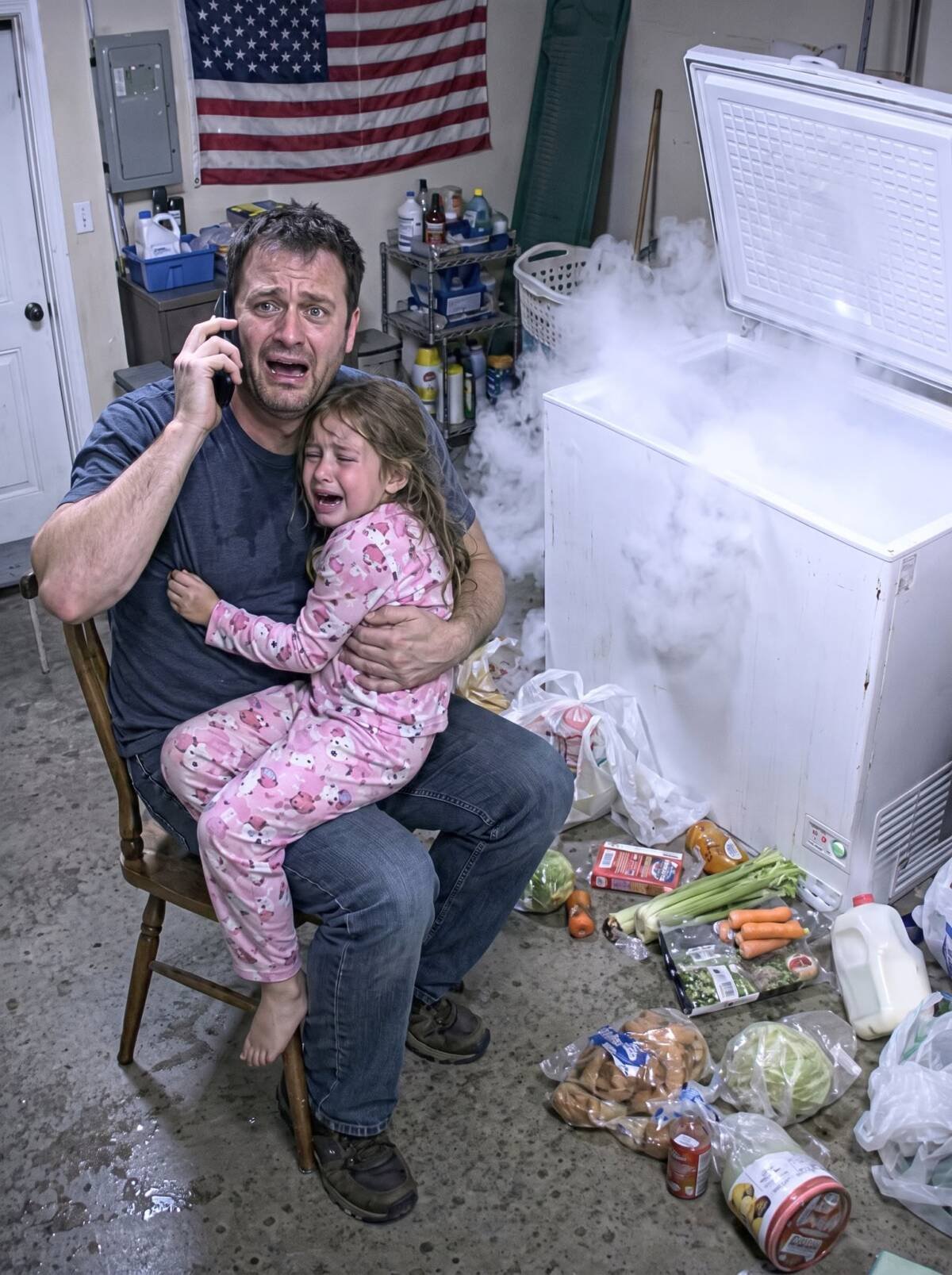
When Daniel Carter kicked open the emergency room doors at St. Matthew’s Hospital, he believed he was fighting to save two lives. His wife, Mia, was limp in his arms, her skin pale and clammy, her dark hair clinging to her forehead. Beneath her oversized knit sweater was the rounded silhouette of the son they had spent eight months preparing to welcome into the world.
“She’s eight months pregnant!” Daniel shouted into the glare of the fluorescent lights, his voice cracking with terror. “She collapsed in the bathroom. Please—someone help her!”
Within minutes, Mia was in a trauma bay surrounded by monitors, IV lines, and a team of nurses moving with practiced urgency. Daniel gripped the foot of the hospital bed, praying to hear the steady gallop of his unborn son’s heartbeat on the fetal monitor.
Instead, a nurse lifted the hem of Mia’s sweater—and froze.
Seconds later, a heavy, flesh-colored silicone pregnancy belly slipped from a wide elastic strap, rolled off the edge of the mattress, and struck the linoleum floor with a dull, rubbery thud.
Daniel stared at the prosthetic at his feet, then back at his wife’s completely flat stomach. His world fractured in a single breath. “Where is my son?” he demanded, his voice echoing off the tile walls.
He thought discovering his wife had faked her pregnancy was the worst betrayal he could possibly face inside that hospital.
He was wrong.
Forty minutes later, when Mia finally opened her eyes, she didn’t beg for his forgiveness. She didn’t even ask if he was leaving her. Instead, she grabbed the attending physician’s wrist with trembling fingers and whispered a warning that would trigger a criminal investigation before sunrise:
“You can’t let his mother in.”
The Night Everything Collapsed
Earlier that evening, the Carter home had looked like the quiet portrait of a couple standing on the edge of a new life.
Down the hall from the master bedroom, the spare room had been transformed into a sunlit nursery. A white wooden crib stood beneath the window, assembled by Daniel over a long Saturday afternoon while Mia sat on the floor folding stacks of newborn onesies. An infant car seat was already locked into the back of their SUV. In the closet sat a packed hospital bag, complete with a soft blue knit blanket Mia had insisted on choosing herself.
They had even picked out a name for their son—one Mia made Daniel promise to keep strictly between the two of them until after the delivery.
For days, Mia had complained of dull stomach cramps and waves of exhaustion. Each time Daniel offered to call her obstetrician, she waved him off with a tired smile. She told him it was normal at thirty-two weeks, that the baby was growing fast and pressing against everything inside her.
Daniel had believed her. Why wouldn’t he? He had watched her cry over the positive pregnancy test in their kitchen eight months earlier. He had framed the grainy black-and-white ultrasound image she brought home from her first appointment. He had listened to the rhythmic whoosh-whoosh of a heartbeat she played from her phone while they lay in bed at night.
Then came the evening she walked into the bathroom saying she felt lightheaded.
Daniel was in the bedroom, plugging in his phone, when he heard the heavy thud against the tile floor.
He found her crumpled beside the vanity sink, unresponsive, her breathing shallow. Panic stripped away every coherent thought. He didn’t wait for an ambulance. He scooped her into his arms, carried her to the car, and drove to St. Matthew’s Hospital with his hazard lights flashing.
At the ER entrance, a triage nurse rushed forward with a wheelchair, but Daniel refused to let go of his wife. His arms were shaking so badly he could barely steady himself, yet surrendering her felt like admitting he had failed to protect her.
“I’ve got her,” he gasped. “Just get a doctor.”
Dr. Rachel Morgan, an emergency medicine physician finishing a chart at the central desk, took one look at the gray pallor of Mia’s face and immediately shifted into command mode.
“Trauma Bay Two. Now,” Rachel ordered.
Two staff members wheeled a gurney into his path. Rachel stepped directly in front of Daniel, locking eyes with him with calm authority. “We need to examine her immediately, sir. Let us take her.”
Daniel finally lowered Mia onto the stretcher. He trailed inches behind the team as they burst through the swinging doors, his shoulder brushing the metal guardrails.
Inside the trauma bay, the room came alive with the sharp rustle of sterile packaging and the rising cadence of electronic monitors. Nurses attached cardiac leads and wrapped a blood pressure cuff around Mia’s upper arm while Rachel pressed two fingers against her carotid artery.
“Talk to me,” Rachel said, never taking her eyes off Mia. “What happened before she collapsed?”
Daniel hovered near the foot of the bed, desperate to stay out of the way yet unable to move farther from his wife. “She said she was dizzy. I was in the bedroom, and I heard her fall. I found her by the sink.”
“Did she hit her head?”
“I don’t think so. There wasn’t any blood.”
“Any vaginal bleeding? Contractions?”
“No—I don’t know.” Daniel’s eyes dropped to the thick sweater draped over Mia’s midsection. “She’s been having stomach pain all week. She said it was just the baby getting bigger.”
The blood pressure cuff hissed and flashed its reading. The nurse at the monitor looked sharply at Rachel.
“Seventy-eight over forty-six.”
Rachel’s jaw tightened. Critically hypotensive. “Two large-bore IVs. Push a liter of normal saline wide open, draw a full panel including tox, and get a fetal monitor on her now.”
Daniel gripped the cold steel rail at the foot of the bed until his knuckles turned bone-white. “Is the baby okay?”
“We have to stabilize your wife first,” Rachel replied evenly.
“The baby—he’s eight months along—”
“We are taking care of both of them, Mr. Carter.”
A nurse stepped up to Mia’s left side with the ultrasound transducer and a bottle of conductive gel. She reached beneath the hem of the oversized knit sweater to expose Mia’s abdomen.
Her hands stopped mid-motion.
Rachel caught the hesitation instantly. “What is it?”
The nurse didn’t answer right away. Her brow furrowed as her fingers encountered something dense, smooth, and unnaturally cool. She adjusted the fabric, looked down, and glanced back up at Rachel with wide eyes.
“Doctor…”
“Let me see.”
The nurse slowly lifted the sweater toward Mia’s chest.
The Truth That Hit the Floor
At first, Daniel couldn’t make sense of what he was seeing. A wide beige elastic harness was wrapped tightly around his wife’s ribs and lower back. As the nurse shifted the sweater higher, the tension on the strap gave way.
Something heavy slid sideways off Mia’s torso.
It tipped over the edge of the mattress and hit the floor near Daniel’s sneakers with a solid, unmistakable thud.
For three agonizing seconds, nobody in the trauma bay moved.
Daniel stared down at the floor. Lying beside his shoe was a hyper-realistic silicone pregnancy belly. It was molded to replicate the exact contour, skin tone, and weighted curve of a third-trimester pregnancy—the exact silhouette he had rested his hand against in the dark for months.
Slowly, mechanically, Daniel raised his eyes to the bed.
Without the prosthetic strapped to her waist, Mia’s abdomen lay completely flat beneath the hospital sheet.
The air seemed to vanish from the room.
“Where is my son?” Daniel asked. His voice was eerily quiet.
Rachel paused for a fraction of a second, her mind racing to reconcile the clinical emergency in front of her with the bizarre reality on the floor.
Daniel took a step forward. “Where is he?”
No one answered fast enough.
“She’s pregnant,” Daniel said, louder now, as if saying it firmly enough could rewrite what his eyes were seeing.
Rachel turned to the charge nurse by the door. “Escort him outside.”
“No!” Daniel jerked back before anyone could touch his arm. “I’m not going anywhere.”
“Mr. Carter, your wife’s blood pressure is dangerously low,” Rachel said, stepping between him and the bed. “We need space to keep her alive.”
“She is eight months pregnant!” Daniel’s voice shattered on the words. “We heard his heartbeat! She showed me the ultrasounds! I built his crib!”
Rachel kept her expression steady. She had no answers to give him, only a critically unstable patient who needed immediate intervention. “We don’t know what happened yet, Mr. Carter. I need to examine your wife and run diagnostics.”
“You just saw that thing fall off her!”
“I saw it,” Rachel said gently. “And I promise you, the moment I have medical answers, I will give them to you. Right now, I need you in the hallway.”
Daniel looked past the doctor at Mia. She lay motionless beneath the bright overhead lamps, her face pale and vulnerable, IV tubing taped to her arm. The sudden surge of rage drained out of him almost as quickly as it had arrived, leaving behind a hollow, terrifying vertigo.
Two nurses gently guided him by the elbows.
“I’m her husband,” he murmured, his resistance gone.
“We know, sir. You’ll be right outside the glass.”
Eight Months Rewritten in Silence
Daniel stood inches from the observation window, watching the medical team cut away Mia’s sweater, attach additional leads, and adjust the IV drip. A nurse offered him a chair, and though he initially refused, his knees eventually buckled enough that he had no choice but to sit.
He stared through the glass, and piece by piece, the last eight months began to unravel in his mind.
He remembered how Mia had stopped changing clothes in front of him around the fourth month, laughing it off as pregnancy insecurity. He remembered the soft click of the bathroom lock every time she showered. He remembered how she had started flinching slightly whenever he placed his palm on her stomach, telling him the baby was kicking her ribs and making her sore.
He remembered the prenatal appointments he had tried to clear his calendar to attend—only for Mia to text him an hour beforehand saying the clinic had rescheduled, or that they were restricting guests because of a seasonal flu outbreak.
Every single excuse had sounded completely reasonable to a man who loved his wife and trusted her unconditionally.
He even thought of his mother, Evelyn. Evelyn had been unusually attentive throughout the pregnancy, buying boxes of high-end baby clothes, checking in on Mia daily, and reassuring Daniel whenever he worried about missing an appointment.
Inside the trauma bay, Rachel ordered a bedside abdominal ultrasound the moment Mia’s blood pressure stabilized enough to tolerate the exam.
As the gray-and-white static resolved on the portable screen, Rachel studied the monitor in silence.
There was no fetus. There was no active pregnancy. There was also no physical evidence of a recent full-term delivery.
What she did see, however, were subtle physiological markers consistent with a pregnancy that had ended months earlier.
Mia hadn’t been lying from day one. She had been pregnant. She simply wasn’t pregnant anymore.
Rachel glanced through the glass at Daniel. He was sitting hunched forward, elbows braced on his knees, both hands pressed tightly over his mouth.
When a nurse stepped into the hallway to fetch additional supplies, Daniel stood up instantly.
“Is she awake?”
“Not yet, sir.”
“Just tell me one thing,” Daniel pleaded, his eyes red-rimmed. “Is there a baby or not?”
The nurse hesitated, looking down at her clipboard. “Dr. Morgan will be out to explain everything in just a moment.”
Her silence was louder than any diagnosis.
Daniel turned away and dragged both hands down his face. He didn’t weep. He looked like a man expending every ounce of strength he possessed just to remain standing while the foundation of his entire life gave way beneath him.
The Warning in a Whisper
Roughly forty minutes after the silicone belly hit the floor, Mia’s blood pressure climbed back into a safer range. Her heart rate steadied. Slowly, her eyelids fluttered open beneath the fluorescent lights.
Rachel leaned in immediately. “Mia? Can you hear me? You’re at St. Matthew’s Hospital. You fainted at home.”
Mia swallowed hard, her throat dry. “What… what happened?”
“Your blood pressure dropped dangerously low,” Rachel said calmly. “We’re giving you fluids and monitoring you closely. You’re going to be okay.”....