The rhythmic beeping of the intensive care monitor was the only sound keeping me grounded. On the other side of the glass, my ten-year-old daughter, Katie, lay pale and motionless beneath a tangle of IV lines and wires. Hours earlier, she had been walking her usual route to gymnastics practice when a car struck her in a crosswalk and sped away.
My phone vibrated in my hand. When I saw my husband Andrew’s name light up the screen, relief washed over me. I answered immediately, expecting to hear his voice asking for an update on our daughter’s condition.
Instead, I heard the sharp, impatient voice of his mother, Barbara.
She wasn’t calling to ask if Katie would survive. She was calling to remind me that her sixtieth birthday dinner was the following evening, the guests were already invited, and she expected me home to cook. When I refused to leave my daughter’s bedside, Barbara delivered an ultimatum that should have been laughable: come home and prepare the meal, or lose my house.
I didn’t leave. And the next morning, when Katie finally opened her eyes and weakly whispered three words—“Andrew pushed me”—the truth began to unravel. What looked like a tragic hit-and-run was actually the centerpiece of a cold, calculated plot. And when police later uncovered a forged power of attorney designed to sell my house out from under me, Barbara Carter’s composure shattered for good.
The Ultimatum at the ICU Door
Tuesday afternoon had started like any other. Katie had packed her gymnastics bag, kissed me goodbye, and headed down the familiar neighborhood route she walked every week. Less than twenty minutes later, my phone rang with the call every parent dreads. A witness had found her lying near the crosswalk after a dark vehicle struck her and failed to stop.
By the time I reached the hospital, doctors had already moved her to the Intensive Care Unit. Her injuries were severe enough that the next twenty-four hours were critical. I stood outside her glass-walled room for hours, my hands pressed against my chest, praying for any sign of improvement.
When Andrew’s name finally appeared on my phone, I pressed accept without hesitation.
“Where are you?” Barbara’s voice snapped through the speaker.
“The hospital,” I replied, too exhausted to hide my disbelief.
“Andrew told me she was stable.”
“She is in the ICU, Barbara.”
“Yes, but stable.”
Her tone was brisk, dismissive, and entirely devoid of warmth. Barbara’s sixtieth birthday dinner was scheduled for the next night. Weeks earlier, she had invited a dozen guests and casually volunteered me to prepare the entire meal—a habit she had perfected over the years.
“Barbara, Katie was hit by a car,” I said quietly.
“You are always so dramatic, Amanda.”
That single sentence summed up a decade of my marriage. For years, Barbara had treated my patience as a personal entitlement. Whenever she crossed a line, Andrew would pull me aside, speak in his calm, reassuring voice, and urge me to keep the peace. “You know how Mom gets,” he would say. “Just let it go. It’s easier for everyone.”
Over time, I had swallowed so much frustration in the name of harmony that Barbara genuinely believed she owned my time—and my life.
Then she delivered her threat.
“Come back tonight and help me get the kitchen ready,” she said coldly, “or do not expect to come back at all.”
I stared at the hospital floor. The threat was absurd on its face. Barbara didn’t own our house. Her name wasn’t on the deed, she wasn’t on the mortgage, and she hadn’t contributed a dime toward the furniture inside it. Yet Andrew had spent years allowing his mother to act as though every major decision under our roof required her signature.
In the background, I heard Andrew’s muffled voice weakly telling her to stop. A moment later, the phone shifted, and Andrew came on the line.
“Amanda,” he said, using that same measured, soothing tone I had heard a thousand times before. “Katie is stable.”
“She is in intensive care, Andrew.”
“I know, I know. It’s scary. But Mom is really upset, and she has people coming tomorrow night. Everything is already planned.”
I looked through the glass at two nurses adjusting the monitors beside my ten-year-old daughter’s bed. My husband was standing miles away, asking me to worry about a birthday roast while our child fought to wake up.
“No.”
I didn’t raise my voice. I didn’t argue. I simply ended the call, turned my phone on silent, and walked back into Katie’s room. I pulled a chair beside her bed, took her small hand in mine, and didn’t let go for the rest of the night.
Three Words That Changed Everything
Morning light was just beginning to filter through the hospital blinds when I felt a faint twitch against my palm. Katie’s fingers curled weakly around mine.
I leaned forward, my heart pounding. Slowly, her eyelids fluttered open. Her eyes were clouded with pain and medication, but the moment they focused on my face, she recognized me.
“Mama?” she whispered.
“I’m right here, baby. I’m right here.”
Before I could call the nurse, Katie’s gaze shifted past my shoulder toward the closed door of the ICU room. Instantly, the confusion in her eyes gave way to pure, unmistakable terror. Her heart monitor spiked, beeping faster.
“Andrew did it,” she whispered.
The air left my lungs. I froze, still holding her hand.
“Baby, what do you mean?”
“He pushed me.”
Her voice was barely audible, strained and trembling, but her words were clear. She told me she had been waiting at the edge of the crosswalk when she felt two hard hands shove her from behind, sending her stumbling directly into the path of an oncoming car. As she fell, she had twisted her head around—just enough to see a familiar black jacket, a pulled-up hood, and a pair of white sneakers.
She knew those clothes. They belonged to Andrew.
A nurse who had just stepped inside the room to check Katie’s vitals overheard her. The nurse’s expression shifted immediately from routine care to quiet urgency. Without a word, she nodded at me, understanding the gravity of what a ten-year-old child had just disclosed.
I called the police immediately.
Before noon, Detective Mark Reynolds arrived at the hospital. He was a calm, observant investigator with a steady presence that put Katie at ease. With me sitting beside her, he gently asked her to walk through what had happened—not once, but several times, carefully checking for inconsistencies or confusion caused by her medication.
Katie didn’t waver. Every time she told the story, the details remained exact: the crosswalk, the sudden shove against her back, the black jacket, the white shoes, and Andrew.
When she finished, Detective Reynolds slowly closed his notebook and looked at me.
“Do not call your husband,” he said quietly. “Do not text him. Act as if nothing has changed.”
The House of Secrets
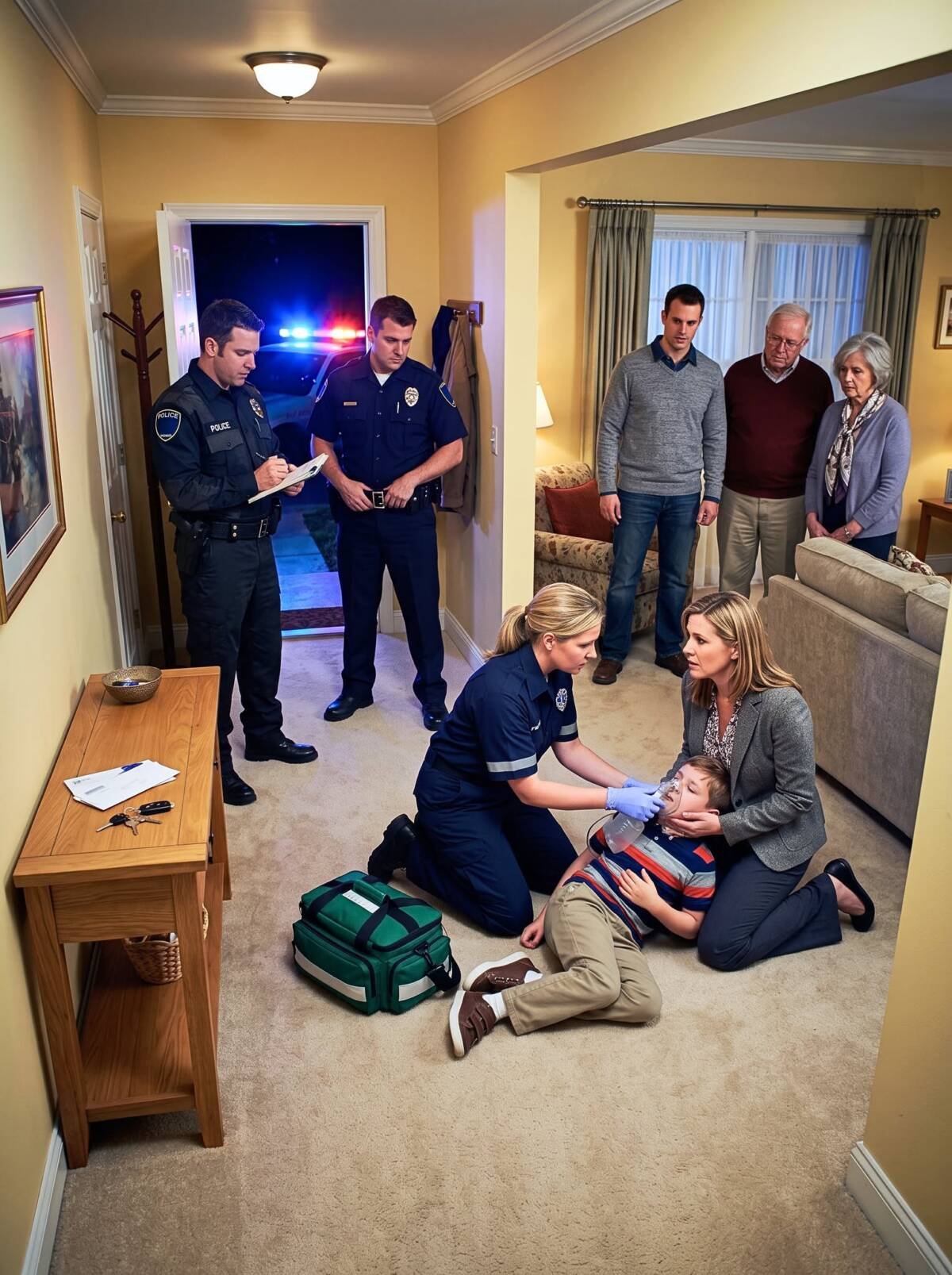
Two uniformed officers accompanied Detective Reynolds and me back to my house early that afternoon. When I unlocked the front door, the contrast between the ICU and my own kitchen was sickening.
Stacks of serving platters, fresh flowers, and neatly arranged ingredients for Barbara’s birthday dinner covered the countertops. The house looked ready for a celebration.
Detective Reynolds barely glanced at the kitchen. Instead, his eyes locked onto the coat rack near the front entrance. Hanging there was Andrew’s heavy black jacket.
Reynolds put on a pair of latex gloves and leaned in close. Caught near the edge of the right cuff was a single, pale blue thread.
My stomach dropped. It was the exact shade of Katie’s school uniform.
With my consent, the officers searched the rest of the house. In our master bedroom, they found a movie ticket stub resting neatly on Andrew’s nightstand, timestamped for the previous afternoon—an alibi placed right out in the open.
Then Detective Reynolds opened the bottom drawer of Andrew’s desk.
Tucked beneath a stack of old utility bills was a manila folder I had never seen before. Reynolds pulled it out, opened it on the desk, and went completely still.
The first document was a recently updated life insurance policy naming Katie as the insured.
Beneath it was a legal power of attorney. At the bottom of the page was a signature that looked remarkably like mine—except I had never seen the document, let alone signed it. The paperwork granted Andrew full legal authority to sell our house in the event that I became unavailable or incapacitated.
Underneath the forged document were printed real estate listings for luxury condominiums in Miami. Scrawled diagonally across the top listing in bold red ink were four words:
“After the problem is handled.”
The room seemed to tilt beneath my feet. I had to grip the edge of the dresser to stay upright.
Detective Reynolds carefully slid the folder into a clear evidence bag.....