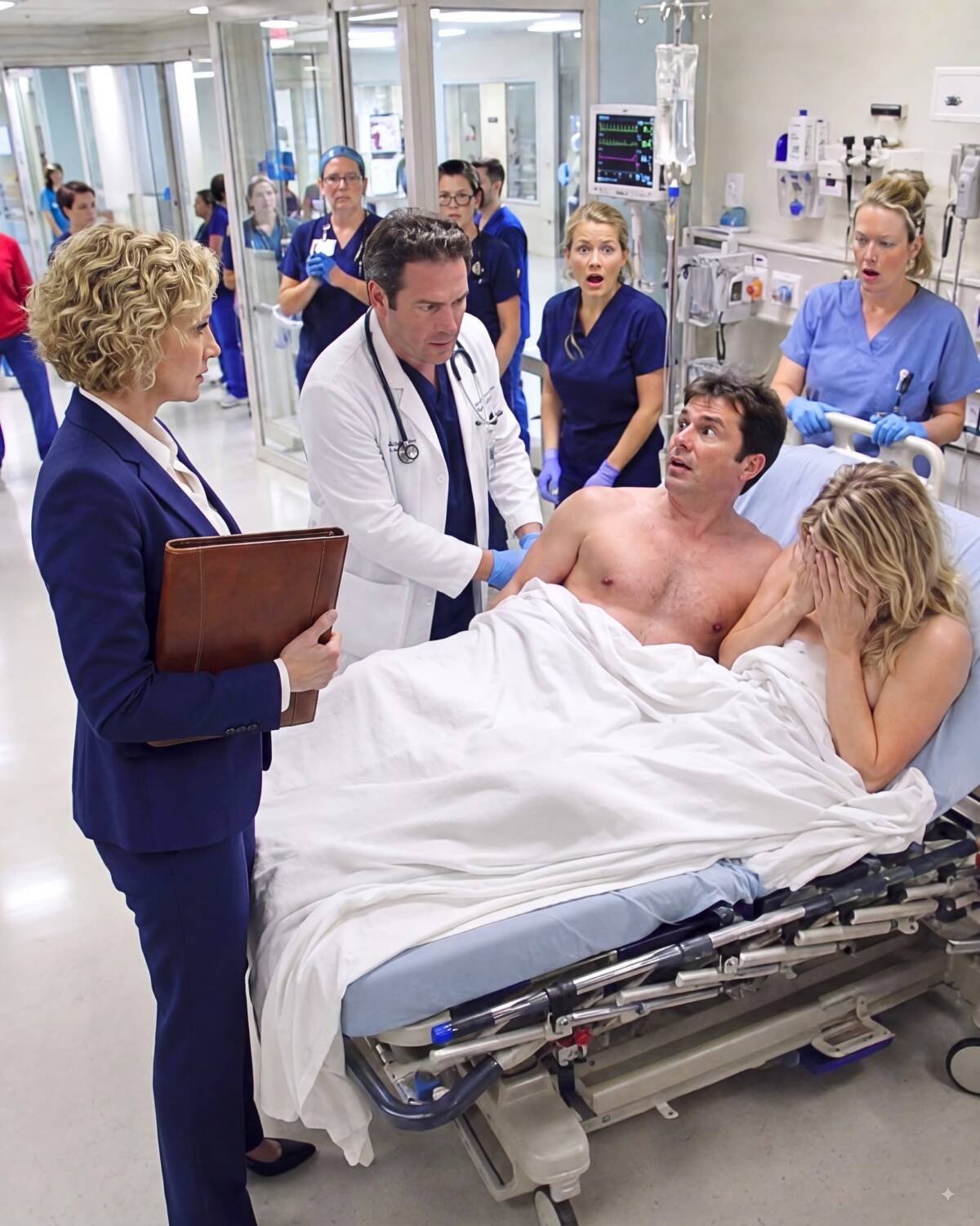
Death rarely arrives quietly, but sometimes it leaves behind echoes that refuse to be silenced. When thirty-five-year-old Bertha Sterling supposedly collapsed from sudden heart failure, her grieving mother, Amanda—a seasoned veteran of thirty years in emergency medicine—knew something was terribly wrong. Healthy young women do not simply die without a cause. Yet, her husband, Christopher, demanded an immediate cremation and refused an autopsy with chilling urgency.
It wasn’t until Bertha’s funeral, amidst the overpowering scent of lilies and the quiet hum of a hundred mourners, that seven-year-old Veronica tugged desperately at her grandmother’s hand. Whispering words that defied explanation, the little girl ignited a chain of events that unraveled a calculated murder, exposed a web of financial deception, and delivered justice from the edge of the grave.
Chapter 1: The Warning at the Funeral
The drive to the funeral home felt almost unbearable. Outside, the morning was gray and bitterly cold, but even with the heater running at full power, I couldn’t shake the chill that seemed to have settled inside the car. The frost clung to the windshield in intricate, jagged patterns, resembling frozen webs that mirrored the tangled anxiety gripping my chest.
My seven-year-old granddaughter, Veronica, sat quietly beside me in the passenger seat, her small frame swallowed by the oversized black coat we had hastily purchased two days prior. She had always possessed an unusual sensitivity, an intuitive grace that allowed her to notice things other people couldn’t explain or even perceive. But on the morning of her mother’s funeral, that strange gift frightened me more than ever before.
Without warning, Veronica grabbed her throat, her small fingers clutching at the collar of her dress as she struggled to breathe. Her eyes widened with sudden, unadulterated terror.
“Grandma… Mommy is here.”
I turned toward her, instantly alarmed by the anguish spreading across her pale, delicate face. The car drifted slightly toward the shoulder before I corrected the steering wheel with trembling hands.
“She’s in the backseat,” Veronica gasped, tears finally spilling over her lashes. “She’s crying so hard. She wants to say something to us, but no one is listening to her.”
I hit the brakes and pulled over onto the deserted snowy shoulder, my heart pounding a frantic rhythm against my ribs. My daughter Bertha had been only thirty-five years old, vibrant, active, and seemingly in perfect health when she supposedly died from sudden heart failure less than seventy-two hours ago.
After thirty years working as an emergency room nurse—decades spent reading monitors, stabilizing trauma patients, and recognizing the subtle, unmistakable signs of physiological collapse—I knew enough to question that neat, tidy explanation. Healthy young women didn’t simply drop dead without an underlying pathology. Everything surrounding Bertha’s sudden demise had left me deeply, agonizingly uneasy.
Most troubling of all was her husband, Christopher.
When we finally reached the funeral home, the overpowering, sickly-sweet scent of white lilies filled the dim chapel. Christopher stood beside Bertha’s open casket in an expensive, impeccably tailored Italian suit, accepting hushed condolences with a practiced solemnity. He lowered his head at precisely the right moments, projecting the exact image of the devastated widower the grieving community expected to see.
Yet, as I watched him from the back of the room, a chilling realization washed over me. There was something fundamentally vacant, something chillingly calculated missing from his eyes. There was grief for show, but no sorrow in the soul.
Only hours earlier, Christopher had made one thing unmistakably clear during a tense confrontation in the hallway: there would be no autopsy. He claimed it was to spare the family further trauma, but he had already finalized arrangements for Bertha to be cremated immediately following the final prayer. He refused to entertain any discussion of delaying it.
That unseemly haste terrified me. Within hours, my daughter’s physical body and any forensic evidence it might harbor would be reduced to ash, scattered to the winds, and silenced forever.
The organ music swelled, signaling the start of the service. I sat beside Veronica in the second row while the pastor delivered a platitude-filled eulogy about Bertha’s gentle spirit. Then, my granddaughter suddenly started trembling from head to toe.
Her small fingers wrapped painfully around mine, her grip so fierce my knuckles turned white, while cold sweat instantly beaded across her forehead.
“Grandma,” she whispered, her voice barely audible over the low murmur of the mourners. “Mommy is screaming!”
I stared down at her, paralyzed for a fraction of a second by the sheer intensity in her wide, frightened eyes.
“She says he’s lying,” Veronica sobbed, shaking violently. “She says… he’s going to burn the proof! You have to look under her dress!”
For several agonizing seconds, I couldn’t move. The weight of the world seemed to press down upon my shoulders, trapping me between the social expectations of a solemn funeral and the frantic, desperate plea of a terrified child.
Then I looked toward the front of the chapel. Christopher.
Instead of appearing confused, defensive, or heartbroken by Veronica’s audible outburst, he shifted nervously on his feet and glanced sharply toward the heavy oak doors where two private funeral home security guards stood watch. Something in his evasive, guilty reaction snapped the last thread of my hesitation. I knew with absolute certainty that if I remained seated in that pew, I might lose my only opportunity to discover what had truly happened to my daughter.
I stood up so abruptly that my wooden chair scraped loudly against the polished chapel floor, echoing sharply in the silent room. Conversations instantly cut off, and hundreds of curious, judgmental eyes turned toward me.
I ignored them all, reaching down to take Veronica’s small, ice-cold hand.
“Come on, sweetie,” I said, my voice cutting through the heavy air with steely resolve. “He is not burning her today.”
Christopher stared at me, his jaw tightening as I stepped decisively into the center aisle. The security guards immediately began moving in my direction, exchanging cautious glances. I didn’t slow my pace. I walked straight past them, continuing down the aisle toward the open mahogany casket.
Every instinct, every clinical diagnostic skill I had developed over three decades in emergency medicine was screaming in unison.
Something had been hidden.
I reached Bertha’s casket and leaned over my daughter’s still, waxen face. My trembling hand moved toward the high black lace collar surrounding her neck. Christopher suddenly bolted from the front row behind me, shouting for me to stop, but I slipped my fingers beneath the heavy fabric. And the moment I pulled the lace aside, the entire chapel gasped in horror…
Chapter 2: The Evidence Beneath the Lace
The chapel descended into absolute chaos the instant my fingers closed around the tightly pulled lace at Bertha’s collar. Christopher vaulted over the kneeling rail of the front pew, his carefully controlled facade of mourning instantly dissolving into naked panic.
“Get that crazy old woman away from the body!” he screamed, his voice cracking with unnatural fury.
He rushed toward me, shoving past the hesitant mourners and grabbing my shoulder with enough force to spin me around. But three decades in the ER had taught me how to handle aggressive, unpredictable situations under pressure. I twisted free of his grip with unexpected strength and shoved him backward. Off balance, he stumbled hard against the edge of the altar, bringing down a massive floral arrangement that crashed loudly to the floor. The security guards froze for a crucial second, paralyzed by the sudden violence of the scene.
I turned immediately back to Bertha. Whatever Christopher was trying so desperately to prevent me from seeing had to be concealed directly beneath that high-collared lace.
Gripping the thick, intricately woven fabric, I pulled with all my might.
The material ripped with a harsh, tearing sound, dragging away the heavy cosmetic layer that the mortuary artist had painstakingly applied to conceal the skin beneath.
The chapel went dead silent. The only sound was the heavy, ragged breathing of the terrified crowd.
Dark, mottled bruising stretched in a violent crescent across Bertha’s throat, starkly visible beneath the pale foundation. And right near her right collarbone, partially obscured by the shadow of her jaw, were two small, distinct puncture marks, surrounded by faint yellowish discoloration.
After thirty years in emergency medicine, I had seen countless injuries, trauma patterns, and medical anomalies. I knew instantly that these marks were not the result of natural heart failure or routine medical intervention. They demanded an immediate, rigorous explanation.
I turned slowly around, facing the stunned congregation with my chin held high.
“She didn’t suffer heart failure,” I announced, my voice ringing clear and steady through the vaulted room. “Something happened to my daughter, and these marks were intentionally hidden from us.”
Gasps erupted across the pews like a breaking wave. Dozens of people rose instinctively to their feet, shouting in shock and disbelief. Several funeral guests immediately pulled out their smartphones, frantically recording the scene, while Christopher’s face drained entirely of color until he looked like a corpse himself.
Without a word, he began backing away toward a narrow side exit near the vestry.
Before he could reach the door, the heavy oak main doors swung open. Detective Marcus Diego strode into the chapel, flanked by three uniformed police officers with their hands resting calmly on their utility belts.
“Nobody move! Nobody leaves this room!” Diego’s voice commanded instant authority. He locked eyes with the fleeing widower. “Christopher, step away from that door right now.”....