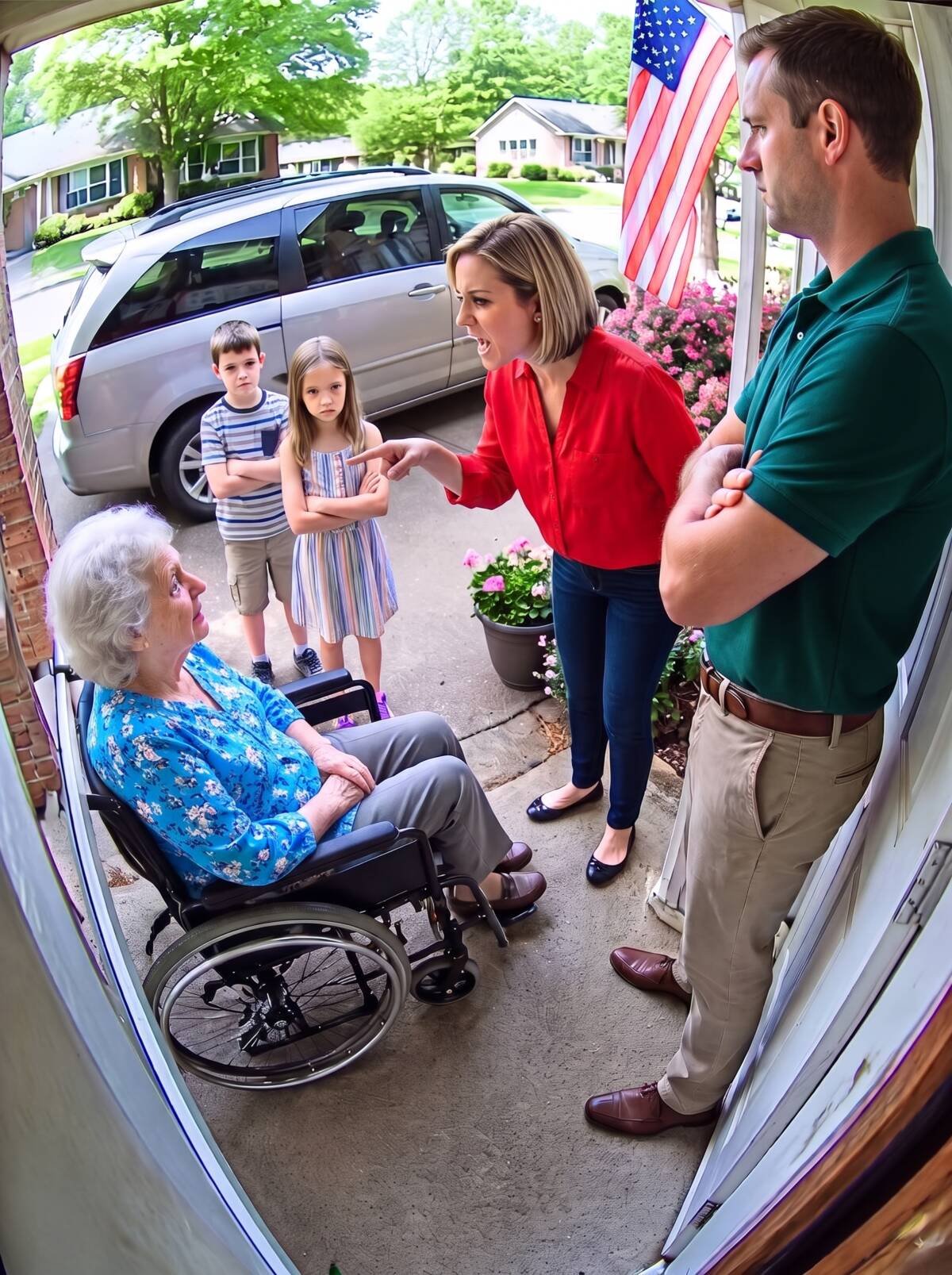
The invitation specified formal attire, white roses, and an afternoon of celebration beneath the crystal chandeliers of the Pembroke estate. But when my mother-in-law opened a velvet case, held up a black animal collar, and sneered, “It’s time she learned where she belongs,” sixty guests erupted in laughter as I clutched my five-week-old baby.
They mistook my silence for weakness, entirely unaware that I was a high-ranking U.S. Army officer—and that my father had taught me never to dismiss a threat.
Part I: The Collateral Damage of Arrogance
The air inside the sunroom was artificially chilled to preserve the white roses that draped every archway and table. Outside, luxury sedans lined the circular gravel drive, their chrome surfaces gleaming under the midday sun. Inside, the elite of Dayton’s financial and social aristocracy mingled over flutes of champagne and silver trays of imported pastries.
My daughter, June, slept against my chest. She was five weeks old, swaddled in a pale pink blanket that still carried the comforting scent of baby lotion and warm milk. To the sixty guests gathered at the Pembroke family estate, we were merely decorative elements—an obligatory domestic addition to a family portrait that required a young mother and child to complete its illusion of perfection.
Margaret Pembroke, my mother-in-law, stood at the head of the room. For three years of marriage to her son Wesley, I had been subjected to her calculated condescension. Coming from a working-class neighborhood outside Dayton, I was viewed by the Pembrokes as a temporary aberration in Wesley’s pedigree. My father, Colonel Thomas Ellis, had spent thirty-two years in the United States Army, instilling in me a worldview defined by operational discipline, unyielding integrity, and a single foundational maxim: Never waste your dignity proving yourself to people determined to misunderstand you. But when someone threatens those under your protection, you act.
I had followed him into service at eighteen. Years of command training, tactical deployments, and strategic security assignments had shaped me into a senior Army officer. Because my responsibilities involved classified national security protocols, Wesley’s family assumed I held some minor, insignificant government desk job. Margaret weaponized that assumption daily. She called me “practical,” handed me cleaning supplies every Christmas while bestowing heirloom diamonds upon her daughters, and once presented me with an embroidered apron emblazoned with the words Know Your Rank.
Everyone had laughed then. They laughed now when Margaret lifted the black leather pet collar from its velvet lining, held it between her manicured fingers, and looked down at my sleeping child.
“She should learn her place,” Margaret announced, her voice carrying easily across the silent room.
Laughter rippled through the guests. It was the easy, thoughtless laughter of people who believed their social elevation rendered them immune to consequence.
I did not smile. I did not move. I simply looked at Margaret, letting the heavy, suffocating quiet of the room stretch out until the laughter died away under the weight of my unblinking gaze.
Margaret stepped closer, her smile hardening at the edges. “Oh, Nora, don’t look so severe. It’s a joke. A family tradition.”
“Put it away, Margaret,” I said evenly.
“It wasn’t cheap,” she replied, reaching directly toward June’s face.
I stepped backward, my boots clicking softly against the marble floor. I tightened my arms around June as she stirred, letting out a soft, distressed whimper.
“Give her to me,” Margaret demanded, her voice rising in irritation. “You’re frightening her with your rigidity.”
“No.”
The word dropped into the room like a lead weight.
For the first time all afternoon, absolute silence gripped the sunroom. Every eye turned toward Wesley. He stood near the buffet table, shifting his weight awkwardly, his gaze darting between his mother and me.
“Mom… maybe that’s enough,” Wesley muttered, his voice lacking any conviction.
Margaret ignored him entirely, her hand still extended toward my child. “Your wife is incapable of taking a joke.”
Instead of anger, an absolute, glacial calm settled over my nervous system. I secured June securely against my chest, pulled my phone from my pocket with my free hand, and engaged the video recorder. I captured Margaret holding the collar, the flushed faces of the uncomfortable guests, the mocking velvet box, and every syllable that had been spoken.
When the recording was saved, I shouldered my diaper bag.
Wesley hurried forward, his expression a mask of panic. “Nora, where are you going? The reception isn’t even halfway through.”
“Home,” I replied, my voice steady and devoid of tremor.
“You can’t just walk out in the middle of a family gathering over a tasteless joke.”
I looked straight into his eyes. “Your mother held a pet collar beside our newborn daughter and declared she belonged beneath your family. You stood there and let her do it.”
“It was just bad humor—”
“No,” I interrupted quietly. “It was a test. To see if I would continue trading my self-respect for your family’s fragile peace.”
Without waiting for an answer, I turned and walked out of the sunroom, past rows of stunned guests, and out toward my car. My hands did not begin to shake until I locked the car doors. I pulled out my phone and sent the unedited video file directly to my father.
His call came through before I could put the phone in the cup holder.
“Are you and June safe?” his voice barked, instantly crisp and operational.
“Yes, Dad.”
“Send me everything,” he instructed. “Do not answer calls from the estate tonight. I am handling this.”
Part II: The Mandatory Summons
The following morning broke under a heavy, bruised sky. Wesley arrived home shortly before dawn, his face ashen, looking as though he had aged ten years overnight. He slumped into the kitchen chair, staring at his hands.
“My father ordered the entire family back to the estate at noon,” Wesley whispered, his voice hollow. “He said attendance is mandatory.”
I poured a cup of black coffee, leaning against the counter. “And?”
“Your father will be there,” Wesley swallowed hard. “And he’s not coming alone.”
At twelve o’clock sharp, my car pulled through the wrought-iron gates of the Pembroke estate. The white roses from the day before already looked decayed, their edges browning in the autumn damp. I refused Wesley’s offer to ride together; trust, once shattered by cowardly complicity, could not be repaired by a shared commute.
My father’s black sedan pulled up beside mine a moment later. He stepped out, dressed in an unpretentious navy suit that possessed more quiet authority than all the wealth displayed across the acreage of the Pembroke estate. He walked over, checked June sleeping peacefully in her carrier, and gave me a sharp, affirming nod.
Two other figures stepped out of his vehicle: Dana Mercer, a fierce military-turned-family-law attorney known for tearing hostile trusts apart piece by piece, and Captain Rafael Ortiz, my father’s former executive officer and a specialist in corporate intelligence and physical security.
“This is not an ambush,” my father said, reading my expression. “It is a structured briefing.”
“Margaret doesn’t respond to structure,” I noted.
“Then today will expand her curriculum.”
Inside the sunroom, the atmosphere had shifted from arrogant celebration to a tense, suffocating tribunal. Nearly all sixty guests from the previous day had returned, their postures rigid, their eyes fixed on the floor.
Charles Pembroke stood at the front of the room, looking profoundly uncomfortable. Margaret stood beside him, her jaw set, though the fierce defiance in her eyes flickered nervously when my father entered the room.
“Colonel Ellis,” Charles began, clearing his throat. “This whole affair has gotten entirely out of hand—”
“It became an actionable threat the moment your wife introduced a restraining device toward my infant granddaughter,” my father interrupted, his voice dropping an octave, cutting through the murmurs of the room.
Margaret forced a brittle smile. “Colonel, surely you understand that elite family dynamics involve a certain… robust humor that outsiders misinterpret.”
“I understand that repeated malice disguised as humor is simply intent,” my father replied smoothly. He gestured toward me. “Nora has absorbed this abuse for years. Yesterday, it crossed into the next generation. That is not a joke. That is an escalation.”
Wesley stood in the corner, his head bowed. The collective silence of the room pressed down on him until he finally broke.
“I should have stopped it,” Wesley said, his voice cracking. He looked across the room at me, his face burning with shame. “I let it happen. I failed my wife, and I failed my daughter.”
Margaret whirled on him. “Wesley, do not sit there and pander to her melodramatics—!”
“Shut up, Margaret,” Charles snapped.
The command was so sudden, so devoid of his usual polished diplomacy, that Margaret staggered back a step as if physically struck.
Charles turned to me, his expression grim. “What do you want, Nora?”....